
Dying or not, everything has a price
I first see the dying city from across a great chasm. Golden walled and perched atop a jagged hill it is a place unlike any I’ve encountered. Beyond those walls lies a remnant of a medieval world, where fortifications both natural and man-made were necessary for survival. From this vantage it appears untouched by the ages since. I have come to find out for myself.
Civita di Bagnoregio stands one-hundred-ten kilometers northwest of Rome, in the region of Lazio. Hailed by Rick Steves and other influencers as a “must-see” destination, it—like San Gimignano, Assisi, and other hill towns in Italy’s heartland—has experienced a boom of tourism in recent years. The main town of Bagnoregio was once only a suburb; now it has a population just over two thousand, while the old city houses less than twenty permanent residents. Each day brightly colored tourists by their hundreds ascend from the commune to Civita aching for a slice of a vision first seen on a digital screen. I am no different.
I take a picture to claim a part of the old city, its walls of sun-baked tufo, its badlands slashing down; then I join the queue for the pedestrian footbridge. This is the only way to or from Civita, save for a millenia old tunnel somewhere far below. A woman scans my five euro entrance ticket and I begin across. Dying or not, everything has a price.
Traffic starts and stops as people pause to take photos along the way. I have spent the last two months backpacking Italy, and on my tour discovered a thousand wonders, a panoply of culture, history, and place. With the forested floor spread out umber and emerald some hundreds of feet below and the antique city looming above, Civita already seems a worthy addition to that list.
Indeed, as I step through the gate into darkness I feel the sense that I am participating in a human history dating back at least thousands of years. I am walking in the footsteps of Renaissance and medieval Italians, and also the Romans, and the Etruscans before them.
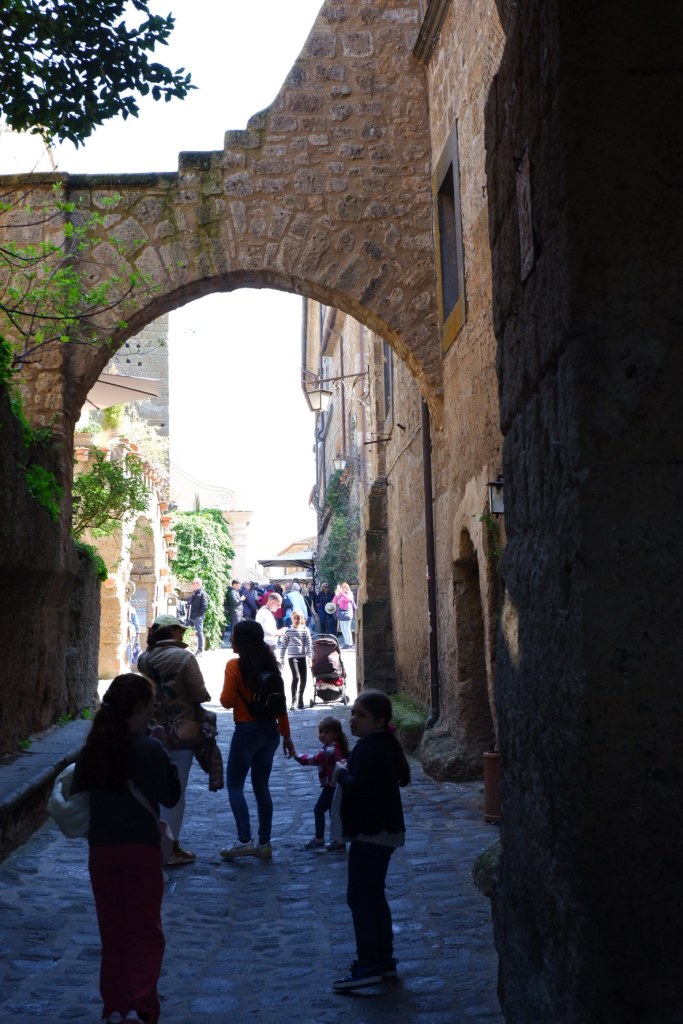
Then I step into the light on the other side. Immediately to my left is a souvenir shop operating out of an old gatehouse. Beyond, a cavalcade of signs cry gelato, pizza, real Italian wine. I’m not interested in food or trinkets, so I pass on down the main road. The crowds stop every couple feet, phones held out like torches in the night to capture pictures of wysteria unfurling down some half-broken facade. It is the same in Venice, Florence, Rome, but here there are no side streets, no narrow vicoli to give me room to breathe. Twice I start down side roads hoping to overpass the traffic, only to find dead ends with young men in serving attire on break scrolling phones and smoking vapes, or else private guest homes with their passageways blocked off.
I rejoin the mass and we shuffle forward slowly, funneled like school kids moving toward the cafeteria. Eventually we spill out into the main square. Piazza San Donato is more or less identical to a hundred other sites I’ve seen before, but it feels entirely different. Tourists sit on dusty steps eating identical sandwiches from the “best panini in Civita”. Some wander in and out of the small church just long enough to take a photo of the bleeding Christ within. Italy’s trademark water fountains are nowhere to be seen, nor are its local people. The architecture is stunning, a marvel of sun and ivy spiraling over local stone—and yet, the only people I see are those like me: visitors, hungry for novelty.
There is no authentic life progressing here. It is only a show, and I feel somewhat like a child watching as the magician stumbles to reveal the multi-colored scarf tucked deep into his sleeve. For years I’ve seen this place on “Top Ten” articles and videos. I have dreamt up a world to fill in the blanks, but instead I’ve stepped into an Italianate version of Disneyland’s Main Street.
The whole city is a tourist trap.
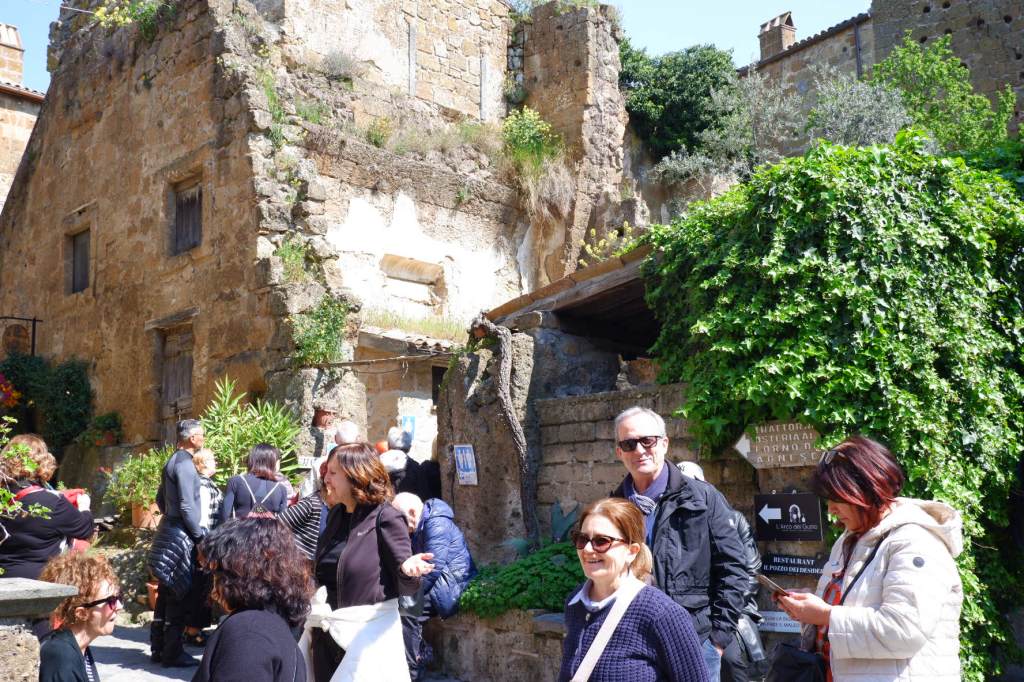
Native writer Boventura Tecchi dubbed Civita “the city that dies” due to the erosion of its hills, which has resulted in numerous landslides and the loss of many historic sites. Like Venice, Civita is history being devoured by time; like Venice, Civita is equally eroded by human forces spiralling out of control. But unlike the Floating City, Civita seems largely divorced from its historical context and local culture. Back in the main town you can still find nonnas sizing up the market fruit, bearded men smoking hand rolled cigarettes, ragazzi making noise outside the express. It is a real place, though it too is shaped for better and worse by the thousands of tourists that come like sweaty children breathing heavy through their streets. Here in Civita, though, there is only the facsimile of a place.
And why not sell one’s history for coin? It is cheaper and easier than growing food, healing wounds, or building affordable homes. Italy contains whole empty cities ready for habitation, but it doesn’t really matter when all of the resources and jobs and glamor remain in Turin, Milan, Rome. Far easier to throw open the gates for a fee, to let the homes of your ancestors become a blank slate upon which we imprint our desire unceasing.
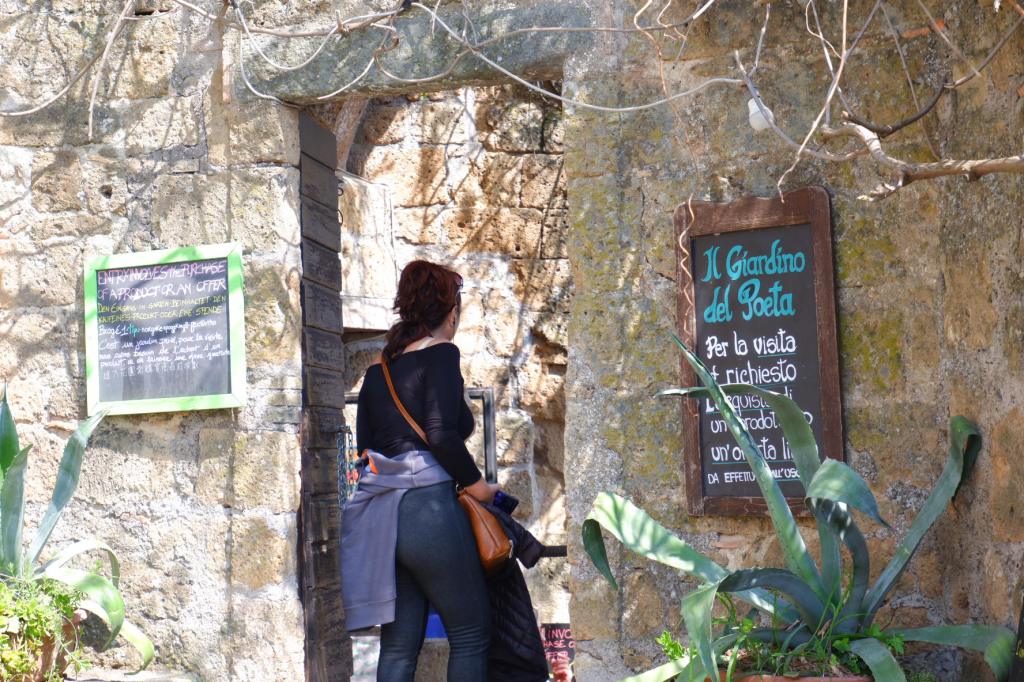
At the far edge of the city is the Giardino del Poeta. From the gate I can smell the wysteria in purple bloom, see the people taking selfies in front of sculpted hedges. There is a sign on the door that says you may enter only with the intent to purchase something at the shop within. There is no public green space, for there is no public here to entangle themselves in its ecosystem.
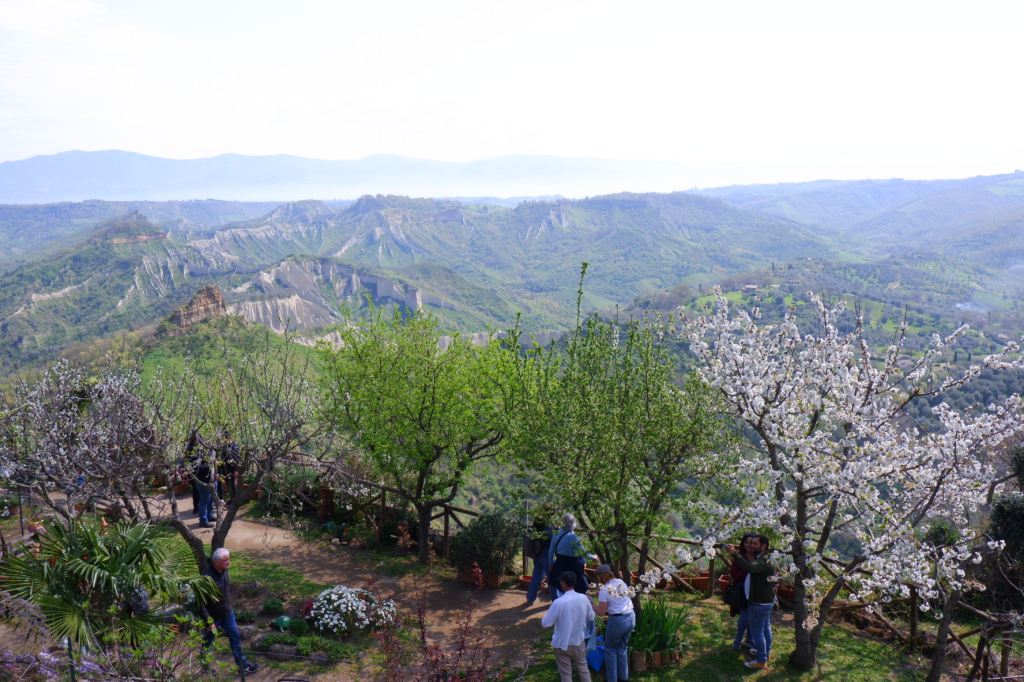
I find refuge at last in a dead-end turn hooking down a side street, abandoned to the landslides. The chain link fences are overgrown with white mustard and poppy and the air blurs with bees. To the south and west the valley is green with primavera and gray with the billowing smoke of controlled burns. To the North the crumbling hills are slashed with green and golden brown.
Among the ruins I sit and try to breathe. Sometimes curious eyes start down toward me, but they always turn back: there is nothing of value for their cameras to see. My watch tells me I have another two hours on the parking meter, but I am ready to leave. There have been other places in Italy I did not enjoy, but never have I found a destination where I could not co-create some meaning until now.
After COVID, I promised myself I would go to see the old, grand places across the sea. How could I allow anything to hold me back now that I knew how easily the privilege of health and travel could go away? As if in response to my own desperate mortality, social media began to flood my feed with a thousand siren calls. Because we live in a system ruled by capital, there was every service ready to transport me between the simulacrum of the screen and the reality of the place.
Desire brought me to this dead-end road just as surely as did that bridge, but it could not make it mean a thing. Only the ethical interplay between people, history, and place can achieve that. Such a relationship begins with openness and honesty, not the snake oil beauty of social media. As it is this city was already dead, and we are not the ones who killed it. We merely stand here taking pictures, hoping to look pretty atop the grave.

 R.M.Harper
Leave a comment